
Gold, Black & Green
It’s time to add green to the palette of official Wake Forest colors, says Dedee DeLongpré Johnston. Should sustainability be its own academic discipline? Should sustainability be infused into courses across the curriculum? Yes and yes, says the director of sustainability, adding that as Wake Forest prepares students to lead the green jobs revolution, the institution is taking a variety of approaches to integrating sustainability into academics.
The green movement is about a change in the way the campus community views sustainability, and about creating a new mindset, especially among students, to look for creative ways to use the earth’s resources more efficiently, says DeLongpré Johnston. “It’s a way of thinking that will give Wake Forest graduates a competitive advantage in the marketplace,” she says. “College graduates entering the job market definitely have an edge if they have developed sustainability-related skill sets. A green job isn’t just a job with ‘sustainability’ or ‘environment’ in the title. From marketing to publishing to accounting to finance, sustainability is a way of thinking that has value across the job market.”
An Eco-Friendly Fashion Show
Featured sustainable clothing, accessories and beauty products modeled by students.
IMPACT: Raised consumer awareness. “People get up and get dressed every day,” says DeLongpré Johnston. “The event gave people an opportunity to take a seemingly ordinary activity and see it in a new way. To be conscious consumers we need to focus on things other than price as a value.”
Two Conferences
“Energizing the Future” and “Taking it to the Next Level: Strategies for Adaption across the Sustainability Curriculum,” drew business and higher education leaders from across the country.
IMPACT: Reflects the university’s commitment to sustainable teaching, research and innovation.
Reusable To-Go Boxes
Offer a sustainable carryout alternative to Styrofoam in the Pit and Magnolia Room. Containers are washed, sanitized and reused. Sustainable practices in dining areas include bulk condiment dispensers and trayless dining.
IMPACT: Reusable condiment bottles kept 20,000 bottles out of the landfill during the 2009–10 academic year; reusable to-go boxes decreased Styrofoam box use by 58 percent, or 32,700 boxes. Trayless dining reduced water consumption by 900 gallons per day.
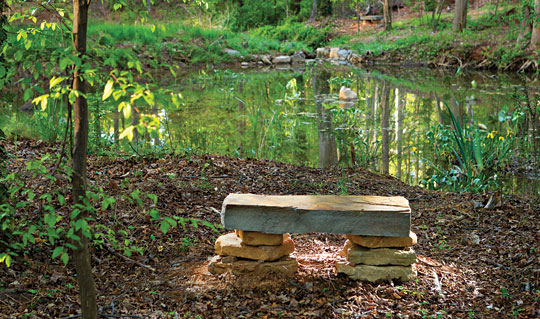
A Meditation Garden
Has been created in what was once just a stormwater run-off area at the corner of Faculty and Wingate Drives.
IMPACT: Walking paths and benches create an ideal space for reflection, meditation and restoration, and indigenous plants are being re-introduced to this already biologically diverse area.
During Earth Hour
Wake Forest joined over 120 countries and more than a billion people around the globe in promoting energy reduction actions by symbolically “flipping the switch” on Wait Chapel’s spotlights.
IMPACT: Raised awareness about energy consumption. Students, faculty and staff signed pledges to reduce consumption beyond just the hour by unplugging unused chargers and turning off unnecessary lighting.
A Solar-Electric Hybrid Shuttle
Carries up to 14 passengers to locations around the Reynolda Campus. “Wake Forest offers a very walkable campus core. For those students, faculty and staff needing a lift to or from the outer edges of campus, the shuttle offers an alternative to driving and parking,” says DeLongpré Johnston.
IMPACT: Fewer vehicles running through campus, improved air quality.
Gasoline Powered Shuttles
Carry riders to and from Deacon Boulevard, the University Corporate Center, Bridger Field House and selected off-campus parking lots and apartment complexes.
IMPACT: Reduced number of vehicles on campus, less gasoline used, and improved air quality. Shuttle service is far more cost-effective than building additional parking lots.
The Zipcar Car-Sharing Plan
Begun in January, offers vehicles for use by students, faculty and staff, on an hourly or daily basis for a small fee.
IMPACT: Reduced number of vehicles on campus, improved air quality and a safer landscape for cyclists and walkers.
Wake Up to Food Week
Was sponsored by Campus Kitchen to promote local and sustainable eating. The event launched the planting season for the Campus-Raised Organic Produce (CROP) program. CROP, a student-managed garden off Polo Road, provides Campus Kitchen with fresh, organic produce. The garden also serves as an outdoor research lab and classroom for faculty.
IMPACT: Increased awareness of sustainable food systems.
Erase the Waste
Ever wondered what happens to plastic bottles collected for recycling? Some 48,000 of them were worn at Commencement on May 17 as the university offered earth-friendly graduation robes. Made from fabric spun from molten plastic pellets, each robe saved about 23 bottles from the landfill. Robes returned to the company were made into carpet fiber.
IMPACT: Increased awareness of sustainable design, and funding to support the campus sustainability program. For each gown reclaimed and repurposed, the vendor made a donation.